How Weight Distribution Hitches Actually Work: The Physics of Spring Bars
If you drop a 8,000-pound travel trailer onto the hitch of a standard half-ton pickup truck, you will immediately notice a severe physical reaction. The rear suspension of the truck will squat down toward the pavement, and the front of the truck will point up toward the sky.
This “squat” is not just an aesthetic issue; it is a massive safety hazard. When the front tires of your tow vehicle are lifted off the pavement, you lose your steering authority, your front brakes lose traction, and your headlights will blind oncoming drivers.
To solve this, the RV industry relies on a heavy, complex piece of mechanical equipment known as a Weight Distribution Hitch (WDH).
It Does Not Reduce Your Tongue Weight
Before explaining how a WDH works, we must dispel the most dangerous myth in towing: A weight distribution hitch does NOT reduce the trailer's tongue weight.
If your trailer puts 1,000 pounds of tongue weight onto the hitch ball, that 1,000 pounds still exists, and it still counts against your truck's maximum payload capacity. What a WDH does is alter how that 1,000 pounds is distributed across the axles of the tow vehicle and the trailer.
The Wheelbarrow Analogy
Think of a WDH like the handles of a wheelbarrow. If you put 100 pounds of dirt in a wheelbarrow and lift the handles, your arms take some of the weight, and the single front wheel takes the rest.
Now, imagine someone pushes down hard on the wheelbarrow handles while you are holding them. The handles act as levers, lifting the back of the wheelbarrow up and forcing more weight down onto the front wheel.
A weight distribution hitch uses this exact same leverage principle. It uses heavy steel spring bars to create mechanical leverage against the truck's frame, lifting the sagging rear bumper up and pushing the front tires firmly back down onto the pavement.
The Core Components
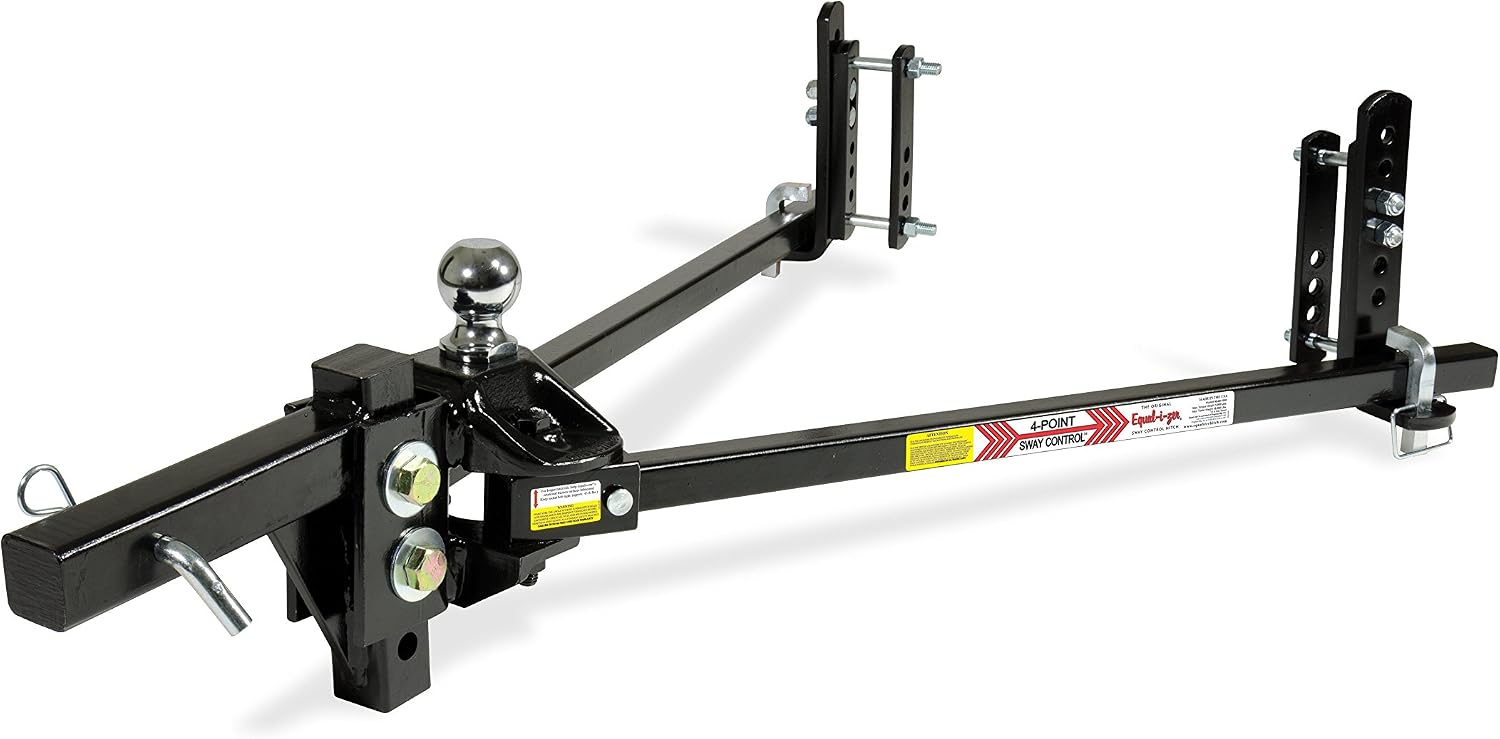
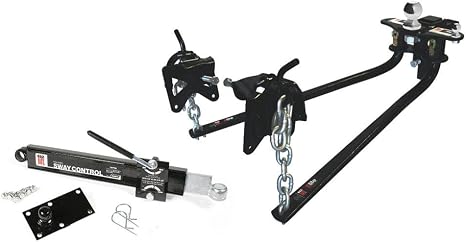
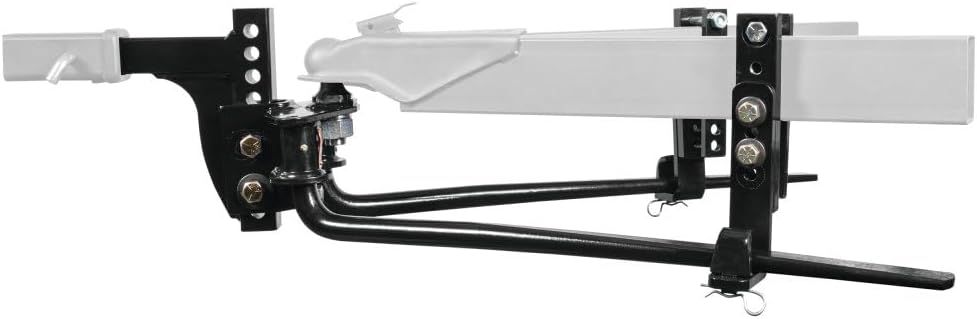
A modern weight distribution system consists of three main structural components:
1. The Hitch Head
This is a massive steel assembly that slides into your truck's receiver tube. It holds the hitch ball, but it also features heavy-duty sockets where the spring bars attach. The head is usually angled slightly downward to create preload tension.
2. The Spring Bars
These are thick, forged steel bars (either round or trunnion style) that act as the levers. One end locks securely into the hitch head on the truck, and the other end extends backward alongside the trailer's A-frame tongue.
3. The Frame Brackets
These brackets are bolted directly to the trailer's A-frame. Once the trailer is dropped onto the hitch ball, the driver uses a special tool to pry the heavy steel spring bars up and lock them onto the frame brackets.
The Physics of “The Lift”
When you lock those heavy steel spring bars onto the trailer's brackets, they are under immense physical tension. They desperately want to snap back straight.
Because the bars are rigidly locked into the hitch head on the truck, this extreme upward tension acts as a giant lever. It physically twists the truck's receiver tube upward. This twisting motion lifts the rear axle of the truck, taking a portion of that 1,000-pound tongue weight and transferring it up to the truck's front steering axle, while simultaneously pushing a portion of the weight back onto the trailer's axles.
The result is a truck that sits perfectly level, with full braking and steering traction restored to the front tires.
Integrated Sway Control
Beyond distributing weight, modern premium WDH systems (like the Equal-i-zer 4-point or the Blue Ox SwayPro) also serve as your primary defense against trailer sway.
They achieve this through friction. Where the spring bars rest on the trailer's frame brackets, there is intense steel-on-steel pressure. If a crosswind or passing semi-truck tries to push the trailer sideways, the friction at these contact points physically resists the turning motion, holding the trailer firmly in a straight line.
Do You Need One?
As a general rule in the automotive industry, if your trailer weighs more than 50% of your tow vehicle's weight, or if the gross trailer weight exceeds 5,000 pounds, a weight distribution hitch is highly recommended, and often legally required by the vehicle manufacturer.
You can check your owner's manual to find the exact threshold for your vehicle. Before you hit the road, ensure your tongue weight is properly dialed in so your spring bars can do their job effectively. Run your fully loaded numbers through our Safe Towing Calculator to verify your setup.