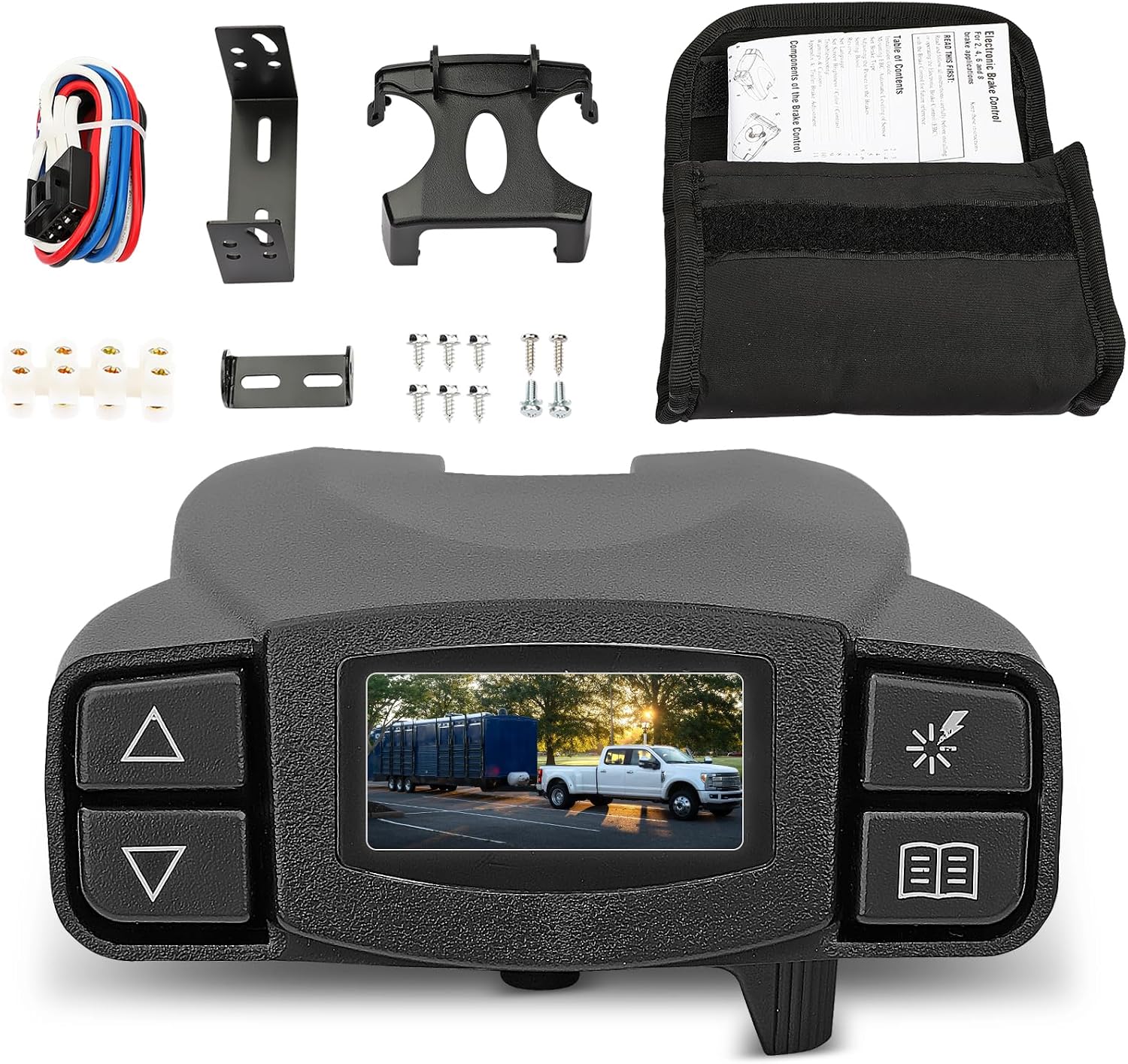
Best Trailer Brake Controllers: Why We Recommend a Proportional P3
If your trailer has electric brakes, we recommend a proportional controller—not a time-delayed one. A proportional unit matches how hard you press the pedal; time-delayed units dump the same force every stop. The Tekonsha Prodigy P3 is the only aftermarket controller we have confirmed. It will not operate surge (hydraulic) couplers.
We are not going to invent Curt, Redarc, or extra Tekonsha SKUs to fill a ten-row table. For how controllers work and how to set gain, read trailer brake controllers explained and proportional vs. time-delayed. Confirm trailer weight in the Safe Tow Calculator before you assume you even need a controller.
Product links on this page are affiliate links. We may earn a commission at no extra cost to you. Read our affiliate disclosure. Star ratings on the cards are Amazon listing ratings, not Safe Tow Calculator lab tests.
Proportional vs. time-delayed (the decision that matters)
Shopping for a “best brake controller” is mostly shopping for a type. The product we link is a proportional unit because that type is the safe default for travel trailers and fifth-wheels with electric brakes.
| Type | How it works | Best for | Not for |
|---|---|---|---|
| Proportional (inertia) | An accelerometer matches trailer-brake voltage to how hard the truck is decelerating | Electric-brake travel trailers, toy haulers, and fifth-wheels; any load that needs smooth and panic-stop braking | Surge / hydraulic couplers; trailers with no electric brake circuit |
| Time-delayed | Sends a pre-set current after you hit the pedal, ramping to a fixed gain regardless of pedal pressure | Light, occasional towing when budget is the only constraint | Heavy trailers, mountain grades, panic stops, anyone who wants the trailer to match a light tap |
The one product we recommend: Tekonsha Prodigy P3
The Prodigy P3 is a proportional aftermarket controller with an LCD, a boost setting, and auto-leveling so mounting angle is less fussy than older inertia units. You still calibrate gain: at low speed on a quiet road, raise gain until a firm stop almost locks the trailer tires, then back off slightly.
We list one controller because that is the confirmed SKU in our catalog. A roundup that invents five other boxes you cannot click is a content farm, not a recommendation. If your truck already has a factory integrated trailer brake controller (ITBC), that unit is also proportional—calibrate it and skip the P3 unless the factory module is missing or failed.
Who the P3 is not for
- Surge (hydraulic) brakes. Boat trailers and some utility trailers use a coupler that applies brakes when the trailer pushes forward. There is no 7-way brake signal to modulate. A P3 will sit on the dash and do nothing useful. See electric vs. surge brakes.
- Trailers without electric brakes. If you are under the typical 3,000-pound threshold and the trailer has no magnets, you do not need a controller. Do not buy one as a lucky charm.
- Trucks with a working factory ITBC. Use the dash control. An extra P3 is a spare, not an upgrade, unless you are moving the controller between vehicles.
How this fits the rest of the setup
A controller does not raise GCWR, payload, or hitch class. It shares stopping work with the truck when the trailer is heavy enough to need its own brakes. After you install it, add the override test to your pre-tow checklist: at walking speed, the trailer should pull the truck down when you slide the manual lever.
If the calculator shows you near capacity on a mountain route, proportional trailer brakes matter more, not less. Run the numbers in the Safe Tow Calculator and read the mountain towing guide before you treat hardware as a substitute for lower gears.