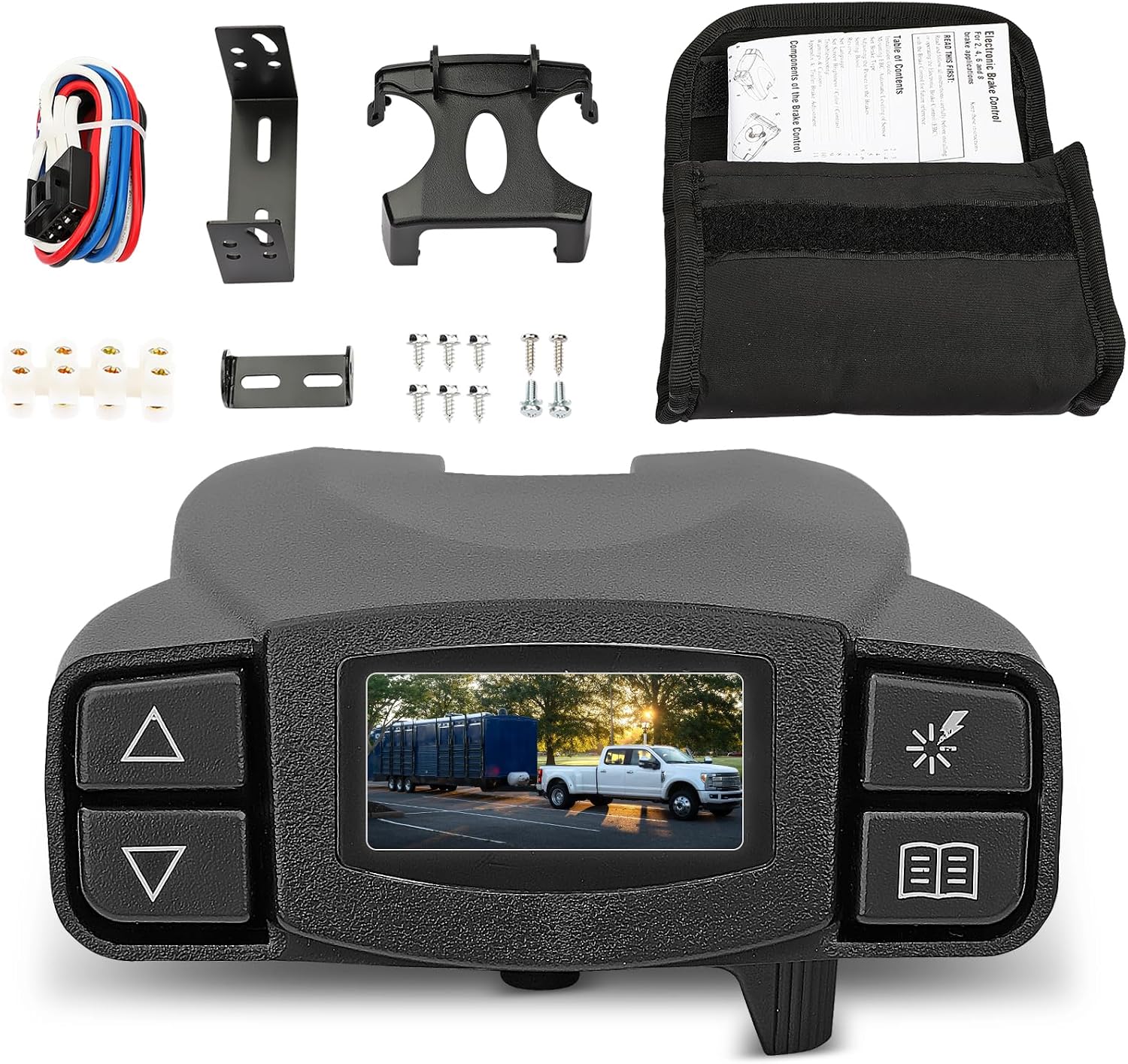
Trailer Brake Controllers Explained: Types, Setup, and Federal Requirements
If you have ever tried to stop a truck with a 7,000-pound trailer pushing it from behind, you know that your vehicle's factory brakes are not enough. Relying solely on your tow vehicle to stop that much rolling mass will overheat your brake pads, warp your rotors, and easily push you into an intersection during a panic stop.
To solve this, manufacturers equip heavy trailers with their own independent electronic braking systems. But those brakes do not work on their own—they need a “brain” inside the tow vehicle to tell them exactly when and how hard to apply the stopping power.
That brain is the trailer brake controller.
The 3,000-Pound Legal Threshold
Before looking at the hardware, you must understand the legal requirements. While towing laws vary slightly from state to state, the universally accepted standard across the United States and Canada is the 3,000-pound rule.
If your trailer's Gross Vehicle Weight Rating (GVWR) or its actual loaded weight exceeds 3,000 pounds, nearly every jurisdiction requires that trailer to have its own functioning brakes on all axles, controlled by a device inside the tow vehicle.
Towing a load over this threshold without a brake controller is not only wildly dangerous, but it also opens you up to severe legal and financial liability in the event of a crash.
Types of Brake Controllers
If your truck did not come with a factory-installed brake controller built into the dashboard, you will need to install an aftermarket unit. When shopping for one, you will encounter two main technologies. Understanding the difference is critical for your safety.
1. Time-Delayed Brake Controllers (The Outdated Budget Option)
A time-delayed controller is the simplest and cheapest option. When you step on your vehicle's brake pedal, this controller sends a pre-set amount of voltage to the trailer brakes, ramping up the power over a specific timeframe (usually a few seconds).
The major flaw with time-delayed controllers is that they do not know how hard you are actually braking. Whether you are gently slowing down for a toll booth or slamming on the brakes to avoid a deer, a time-delayed controller applies the exact same braking sequence. This often results in jerky stops and premature wear on your trailer brakes.
2. Proportional Brake Controllers (The Gold Standard)
Proportional controllers use an internal inertia sensor (an accelerometer) to detect exactly how fast your tow vehicle is decelerating.
When you press the brake pedal, the controller calculates your stopping force in real-time and sends a perfectly mirrored amount of voltage to the trailer brakes. If you tap the brakes lightly, the trailer brakes lightly. If you slam on the pedal, the trailer brakes lock down with maximum force simultaneously.
Proportional controllers provide the smoothest, safest, and most predictable stopping experience. They are highly recommended for all travel trailers, fifth-wheels, and heavy utility loads.
How to Calibrate Your Brake Controller
Once installed, a brake controller must be calibrated to match the specific weight of your trailer. You cannot simply plug it in and hit the highway. If the “Gain” (the maximum power output) is set too high, the trailer tires will lock up and skid. If the Gain is set too low, the trailer will physically push your tow vehicle.
The Standard Calibration Process:
- Hook up your fully loaded trailer and plug in the 7-way wiring harness.
- Locate a large, empty paved area (like a vacant parking lot) with dry conditions.
- Set the controller's Gain dial to a mid-range starting point (usually around 5.0).
- Drive forward at exactly 25 mph.
- Take your foot off the gas pedal, and do not touch the vehicle's brake pedal. Instead, fully engage the manual override lever on the brake controller.
- Evaluate the stop:
- If the trailer tires lock up and skid, lower the Gain setting slightly and repeat the test.
- If you barely feel the trailer slowing you down, increase the Gain setting and repeat the test.
Your perfect calibration is the highest possible Gain setting that smoothly stops the vehicle just before the point of the trailer tires locking up.
Note: You must recalibrate your brake controller anytime your trailer's weight drastically changes (e.g., towing it empty vs. fully loaded).
Completing Your Towing Setup
A high-quality proportional brake controller is a mandatory safety item, but it cannot fix an inherently overloaded vehicle. Trailer brakes will stop a heavy load, but they will not prevent your truck's rear suspension from collapsing if you exceed your payload capacity.
Always verify your entire towing setup—including payload limits, hitch ratings, and required gear triggers—by entering your vehicle's specifications into our Safe Towing Calculator.